C a s e S t u d y

M a r t h a F e w
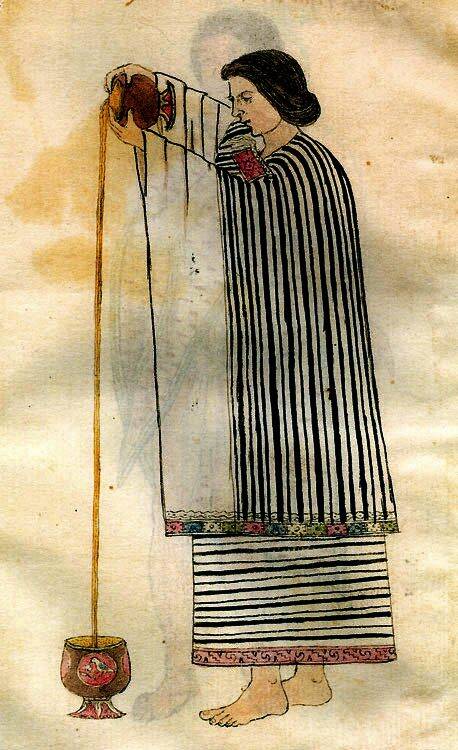
Mujer azteca espumando cacao, reproducción perteneciente al folio 3-r del Códice Tudela
Museo de América
16th century
Anonymous author
☕C h o c o l a t e i n E v e r y d a y L i f e ❀・*・. ° . ✿ 。゚・
In colonial Guatemala, love "magic," or rather hechicería, arrived quietly, in the most ordinary vessel imaginable: a cup of hot chocolate.
Inquisition records from Santiago de Guatemala, present-day Antigua, features chocolate again and again as a vehicle for sorcery, sexual witchcraft, and the negotiation of power between women and men.
The choice of chocolate specifically was very much intentional: It tells us something important about who practiced it and what it meant in the daily lives of colonial women.

。゚・✧・゚: *. 。゚❀ W h y C h o c o l a t e ?☕❀・*・. ° . ✿ 。゚・
Chocolate's role in sorcery was rooted in its cultural history and physical properties as cacao had long held sacred significance for the Maya as currency and a ritual drink before European contact.
By the late seventeenth century, sweetened chocolate had become a staple consumed across all racial and social groups in Santiago. The preparation and serving of chocolate was coded in the domestic sphere, becoming part of women's daily work (few) which explains its commonality present in their spells. Indigenous women working as servants in colonial kitchens taught the preparation of chocolate to Spanish, mixed-race, and African women across the city. Female market sellers sold chocolate drinks from outdoor stalls (Few 2011, 85), setting the stage for what would eventually become a pathway for constrained economic agency.
This ubiquity made chocolate the perfect cover: its dark color, thick texture, and grainy consistency could conceal herbs, powders, and other ritual ingredients without detection (Few 2011, 85). Women were already expected to prepare and serve it, doing so aroused no suspicion.
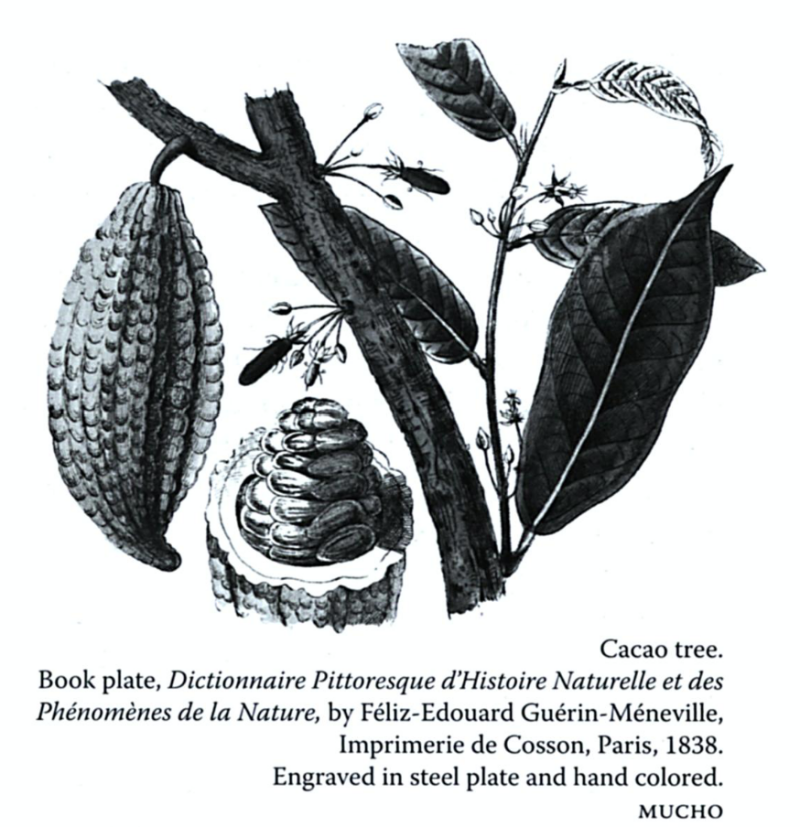
cited in Few (2011)
。゚・✧・゚: *. 。゚❀ What Women Did and Why ❀・*・. ° . ✿ 。゚・
The cases Few (2011) analyzes from the Inquisition records are tailored, yet still varied, to illuminate the commonality of chocolate across all socioeconomic and racial classes. Women of all backgrounds consulted sorcerers to acquire ritual ingredients to exert power over the men in their lives using chocolate as the medium. Purposes for such sorcery typically fell between attracting lovers, ensuring husbands' fidelity, protection, and at times, revenge.
Manuela Gutiérrez, a twenty-year-old mulata servant, reported relationship troubles with a lover and sought out to find a spell to draw him back under the mentorship of a mulata sorcerer named Gerónima de Varaona. The ritual was highly specific: she had to wash her genitals with water, beat that water together with powders into a hot chocolate drink, and give it to the man she desired (Few 2011, 86). The logic was one of bodily transmission: her own body, dissolved into the drink, would bind him to her.
The ritual Few describes here is not only pragmatic, but philosophically dense. Through the lens of constrained agency, the act of spellwork can be reframed to be a purposeful excercise of power within an institution of severe structural limitation. It is crucial to recognize that Gutiérrez's act was neither fully free nor fully determined as she found herself within a deeply oppressive colonial system. She could not claim property, command labor, or leverage institutional authority, leaving her to act through the body. A tripartite framework (Scheper-Hughes and Lock 1987) for understanding the body as site of power is pivotal here to fully situate this within a feminist lens. Whether the power of the body is being constructed, negotiated, or subjugated, all of those are still different forms of agency is itself a theoretical claim that constrained agency demands modern audiences to take seriously. To say that even subjugation involves an individual who navigates and responds to the terms of their own unfreedom is not to romanticize suffering, but to refuse the colonial logic that would render certain people as purely passive, or as objects of history rather than participants in it.
This bodily framework distinguishes the individual/conscious body, the social body, and the body politic to argue that the three levels can operate all at once within relation to each other which is what pushes power to become visible. At the individual level, the logic was one of bodily transmission: her body dissolved into his drink which extended herself into him through the act of consumption. This draws on an understanding of personhood that is fundamentally different from Western philosophies of the bounded subject: an autonomous and self-enclosed person whose selfhood ends at their skin; conveniently working for European men and no one else. At the social body level, she was deploying the culturally charged symbolic weight of chocolate as the medium for her intention, and at the level of the body politic, the act was her only available channel. The colonial state had foreclosed every institutional option, leaving the body itself as the last remaining instrument of agency, thus birthing constrained agency.
Another record detailed the pursuits of Nicolasa de Torres, another free mulata servant, who wished to attract the affections of her employer. Petrona Mungia, the Indigenous sorceror she consulted, instructed her to mix her own pubic hairs with a small worm found under a particular type of stone and add them to his chocolate (Few 2011, 89). Again, the principle was one of physical connection, her body was to be made part of his enacted through the intimate act of drinking.
De Torres's case sharpens the analysis of constrained agency. The man she wished to attract was her employer who controlled her daily survival. What she could not do through refusal or economic negotiation was attempted through a practice that colonial institutions classified as demonic and that twenty-first century Western scholarship would classify as superstition. Both of which are epistemological positions produced by systems invested in discrediting "supernatural" knowledge that did not serve to uphold racial hierarchies. The ritual was legible as threatening precisely because it enacted a dissolution of those symbolic boundaries: her body entering his through the drink was, at the social body level, a subordinate penetrating the boundary of the dominant. Perhaps, the Inquisition prosecuted these cases because there were symbolic inversions of colonial social order in the body.
Constrained agency here operates at every level simultaneously: she was constrained by her servitude, and her response to that constraint required accessing the constrained knowledge of a woman also structurally disspossessed within the colonial hierarchy.
These were not desperate or unusual measures, but rather a part of a recognized repertoire of practice that women across Santiago shared knowledge of and sought out from one another. Women asked neighbors and friends for recommendations on which sorcerers to consult. They acted as go-betweens, acquiring ritual items on each other's behalf. The knowledge circulated through female networks that cut across race and class, the same kinds of networks documented in Cartagena's madrina system.
...click the purple linked text above!
。゚・✧・゚: *. 。゚❀ Elite Women's Participation in Love Magic ❀・*・. ° . ✿ 。゚・
One of the most important things the chocolate cases reveal is that love magic was not exclusive to women of color or of mixed-race descent. Elite Spanish women participated too, and their participation exposes the deep contradictions of the colonial racial system, and arguably raises ethical concerns of these white women co-opting this practice solely for their own benefit. And yet, facing virtually none of the same consequences; in fact, almost none at all (Few 2011, 88).
De Varaona also served as an intermediate for doña Luisa de Gálvez, a woman of elite standing. Doña Luisa paid de Varaona in bread to travel to the home of an Indigenous woman named María de Zumagra and trade for ritual powders. De Varaona returned with three packets: one for doña Luisa to place in the clothing of the man she desired, and two to be mixed into his chocolate and food. Doña Luisa then washed her own body with water and had another woman finish the rest of the ritual (Few 2011. 88). To think that a woman of her social standing, notiously nicknamed "La Machete" for her violent temper, relied on a mulata intermediary and Indigenous knowledge to conduct her love magic says everything about how these networks actually functioned. Elite women used women of color to extract the benefits of criminalized knowledge without reaping any consequences.
This case operates differently from the others and it holds a different place within the theory of constrained agency. Doña Luisa was an elite Spanish woman whose constraints were real, but categorically different from that of Gutiérrez and De Torres. She too desired a manner in which to manipulate a man's will despite structures in place meant to benefit her class and mediate her relationship. The body politic is indispensable here as it operated through the Church, the Inquisition, and the legal codes of caste and gender. All of which ensured that women's bodies were positioned as objects of regulation rather than instruments of will. In order to combat this, she went through the social body to co-opt practices of sorcery. This was only made possible due to her status as a white elite whose body had not been as intensely regulated by the colonial body politic, unlike women of color,
The case of doña Catarina Delgado is a fascinating display of love magic used to enact revenge on her husband, a Spanish sergeant, who had become entangled in a love affair with Agustina, a mulata servant. Naturally, the situation would result in a violent end as Doña Catarina, her husband, and their Indigenous servant drank hot chocolate prepared by Agustina. Doña Catarina fell violently ill, vomiting what she described to be yellow, green, and blood-colored fluids. The servant fell ill and died, however, the husband, believed to be the target of Agustina's anger, remained unharmed (Few 2011, 88).
Whether or not the chocolate was actually prepared to have magical intention, the case shows how thoroughly the association between women and magical harm had penetrated colonial consciousness. In colonial Guatemala, female bodies, especially the bodies of women of color, were the primary symbolic site through which colonial anxieties about disorder and inversion were processed. Agustina's chocolate was "dangerous" not only because it may have caused illness, but because it made visible the symbolic threat that her body already represented to the colonial household: a mulata woman whose bodily knowledge exceeded the control of the people who presumed authority over her. The twist is that the violence, intended or not, was misfired at another vulnerable body, their household servant, who absorbed what was meant for the husband. This was constrained agency at a brutal limit. Colonialism denied Agustina every legitimate channel and yet it was the same system that determined who absorbed the consequences when everything went wrong. The sergeant lived.
。゚・✧・゚: *. 。゚❀ Awareness and Suspicion ❀・*・. ° . ✿ 。゚・
The association between women and bewitched chocolate rapidly increased until men actively feared it and occasionally exploited it. It was no secret that chocolate was used in ritualistic practices, especially with Inquisitorial proceedings actively placing women on trial for initial suspicions of witchcraft.
Manuel Antonio Calderón, a young mulato weaver, characterized his marriage, to Magdalena, as deeply quarrelsome insofar as to proclaim she had cast a stupefying-like spell on him that afflicted his sense of reason. The suspicion arose at the abnormally heavy weight of his chocolate beverage that had been prepared by his wife and family before the next morning, it had festered into a writhing mass of white worms (Few 2011, 87). Records like these may seem unrealistic or perhaps too similar to a dramatic farse for men to control their wives, but the focus of this analysis lies beyond whatever truths or misinformation spread by Calderón.
His testimony reflects the fearful sentiments of men surrounding the "supernatural" practices of the women surrounding them, almost like an inversion of gender dynamics had occured. Now, to say this statement with profound confidence would require houses of academia to declare magic as something real on a material or spiritual plane which is highly unrealistic in Western scholarship as the field itself is still rooted in colonialism. Magdalena's conscious body became, through Calderón's testimony and the Inquisition's processing of it, a body politic threat, a site of social disorder requiring institutional intervention. The transformation from lived body to dangerous body, demonstrates a constant state of politicization. To then evaluate whether Magdalena's magic "really worked" by Western scientific standards is to accept the body politic of colonial scholarship as the final judge, or ultimate truth.
。゚・✧・゚: *. 。゚❀ What the Chocolate Cases Tell Us ❀・*・. ° . ✿ 。゚・
These cases are more than Tribunal records of sorcery under prosecution. They represent an archive of constrained agency of women at nearly every position in the colonial hierarchy reaching for power through mediums that had not been fully sealed. Scheper-Hughes and Lock's (1987) bodily theory offers a comprehensive, analytic framework that encapsulates the complexity in which women navigated their physical world with metaphysical registers. The Inquisition did not prosecute brujeria or hechiceria because it was ineffective, but because it was a dangerous tool that challenged colonial authority authentically. These repertoires of practices existed before colonialism disrupted their lands and dismissed them as demonic or wrong only because they did not serve to enforce the European religious, racial, or socioeconomic hierarchies. They were, in other words, not prosecuted for being false, but for being independent systems of knowledge that answered to a different authority than the Church and circulated through networks the colonial state could not monitor or conscript.
Every document Few (2011) analyzes was produced by a colonial institution whose purpose was surveillance, extraction, and control. Scheper-Hughes and Lock (1987) note that Western biomedicine's assumptions about the bounded, Cartesian body are not neutral scientific observations, but culturally and historically produced frameworks that marginalize other ways of understanding embodiment. The same critique applies to the Western scholarly apparatus that inherited those assumptions. To read these archives as transparent windows onto female experience, or to evaluate the effectiveness of these women's practices by the standards of that same apparatus, is to reproduce the Inquisition's own epistemological claim: that it could capture and contain what it encountered.
Create Your Own Website With Webador