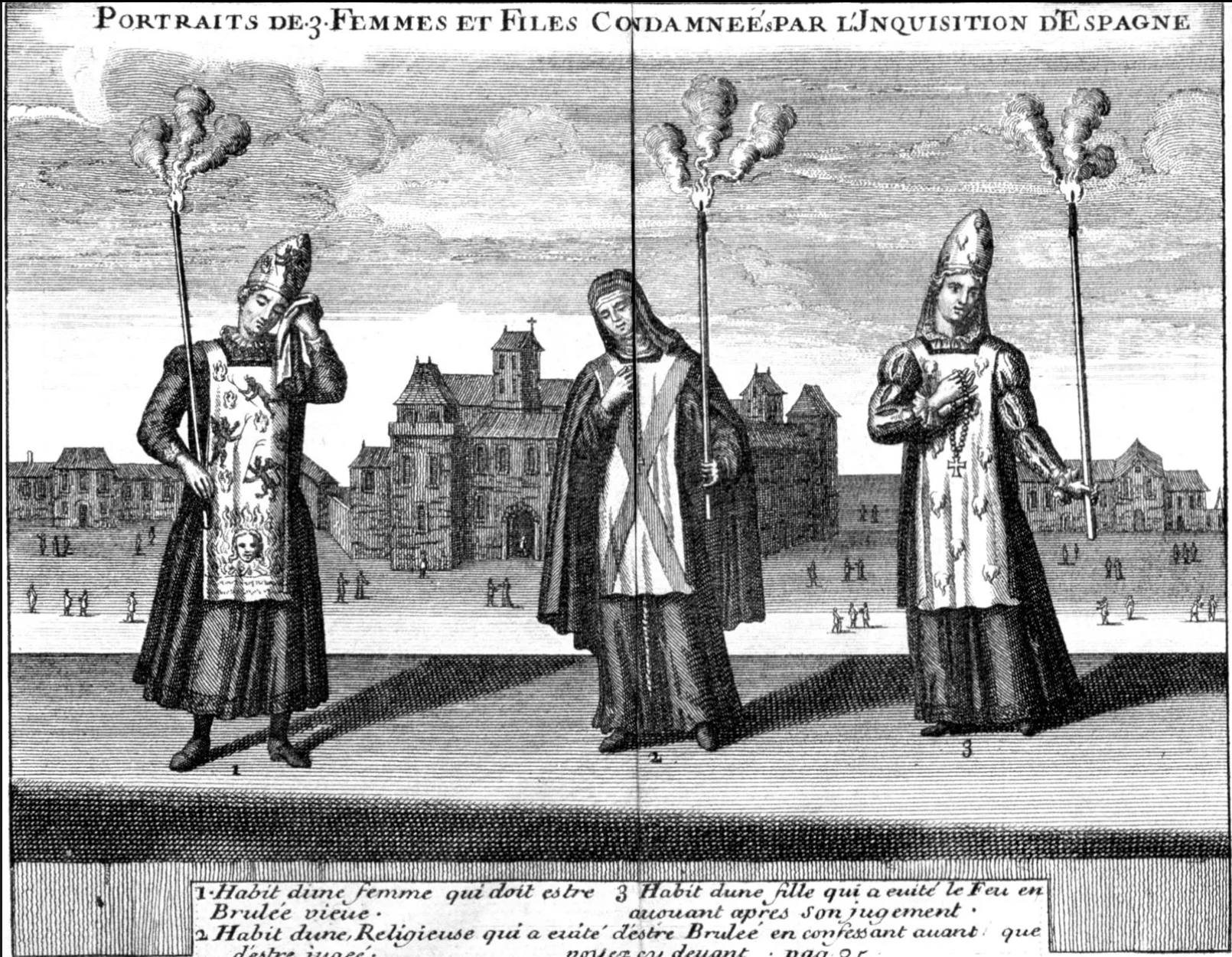
Research Question
What do Inquisition trial records from colonial Colombia and Guatemala reveal about how women of color used sorcery and witchcraft to assert agency, and how colonial institutions (including Spaniard/Creole women) sought to suppress or co-opt that power?


Constrained Agency
Inquisitorial records are not simply documents of crime and punishment, but rather sites of negotiation between colonial authority and the women it sought to control. The argument made here is not that these women were free, but that they operated under brutal systems of racial hierarchy, gendered violence, and religious repression.
To understand their lives, this project draws on a feminist tripartite body framework (Scheper-Hughes & Lock 1987, 12) and the concept of constrained agency (Mahmood 2005): the recognition that meaningful acts of self-determination can and do occur within oppressive structures, especially when they are partial, complicated, and made under duress.
Key Terms to Understand
Brujería
The Spanish term for witchcraft. Under colonial Inquisition law, brujería was one of the most serious charges as it was defined as involving an explicit pact with the devil, meaning the accused had entered into a relationship with demonic forces. This framing made brujería a crime against God and thus, the colonial order which extended the crime beyond simply using forbidden knowledge.
Hechicería
The Spanish term for sorcery or spellwork. Unlike brujería, hechicería was not necessarily understood as diabolical. It referred to the use of charms, potions, rituals, and spells, but without the implication of a devil's pact. It was still a punishable offense, but a lesser one, and it carried significantly less social stigma and legal consequence than brujería.
Hechicería Amorosa
Love magic or love sorcery: a specific type of hechicería concerned with romantic and domestic relationships. This included spells to attract a lover, secure a partner's fidelity, or calm an abusive husband. Also, at times an income-generating practice, making this one of the few available paths to economic independence in a society that otherwise denied women of color financial autonomy.
The Madrina System
Documented in Cartagena trial records, the madrina (godmother) system refers to networks through which healing and magical knowledge was transmitted between women largely outside and colonial control. More experienced practitioners served as mentors to younger women, passing on knowledge of herbs, rituals, spells, and techniques (McKnight).
The Spanish Inquisition (in the Americas)
Originally established in Spain in 1478, the Inquisition was a judicial institution of the Catholic Church with the objective of identifying and prosecuting heresy. Three tribunals were established in the Americas: in Mexico City (1571), Lima (1570), and Cartagena de Indias (1610).
The Tribunal of Cartagena de Indias
Established in 1610, this tribunal was one of the most active in the colonial Americas and had jurisdiction over the northern coast of South America and parts of the Caribbean. Cartagena was a major port and the principal entry point for enslaved Africans into Spanish South America, which made it one of the most racially and culturally diverse cities in the colonial world. This diversity, and the syncretic spiritual practices it produced, made Cartagena a particular focus of Inquisitorial attention.
The Mexico City Tribunal
Unlike Cartagena, colonial Guatemala did not have its own Inquisition tribunal. Cases were instead handled by the tribunal in Mexico City, which had jurisdiction over all of New Spain, including Central America. Established in 1571, it was one of the first Inquisition tribunals in the Americas. The geographic distance between Guatemala and Mexico City may have allowed for Inquisitorial oversight to be less immediate and systematic than in Cartagena, but the same racialized patterns of prosecution persisted regardless.
Syncretic/Syncretism
The blending of different religious or spiritual traditions into new, hybrid practices. In colonial Cartagena, syncretism describes the mixing of African spiritual traditions (brought by enslaved people from many different regions and ethnic groups), Indigenous Amerindian practices, and Catholic ritual into forms of healing, protection, and magic that did not belong entirely to any single tradition. The Inquisition feared and targeted syncretic practice precisely because it represented a spiritual world that existed outside the Church's control.
Create Your Own Website With Webador